Software Development
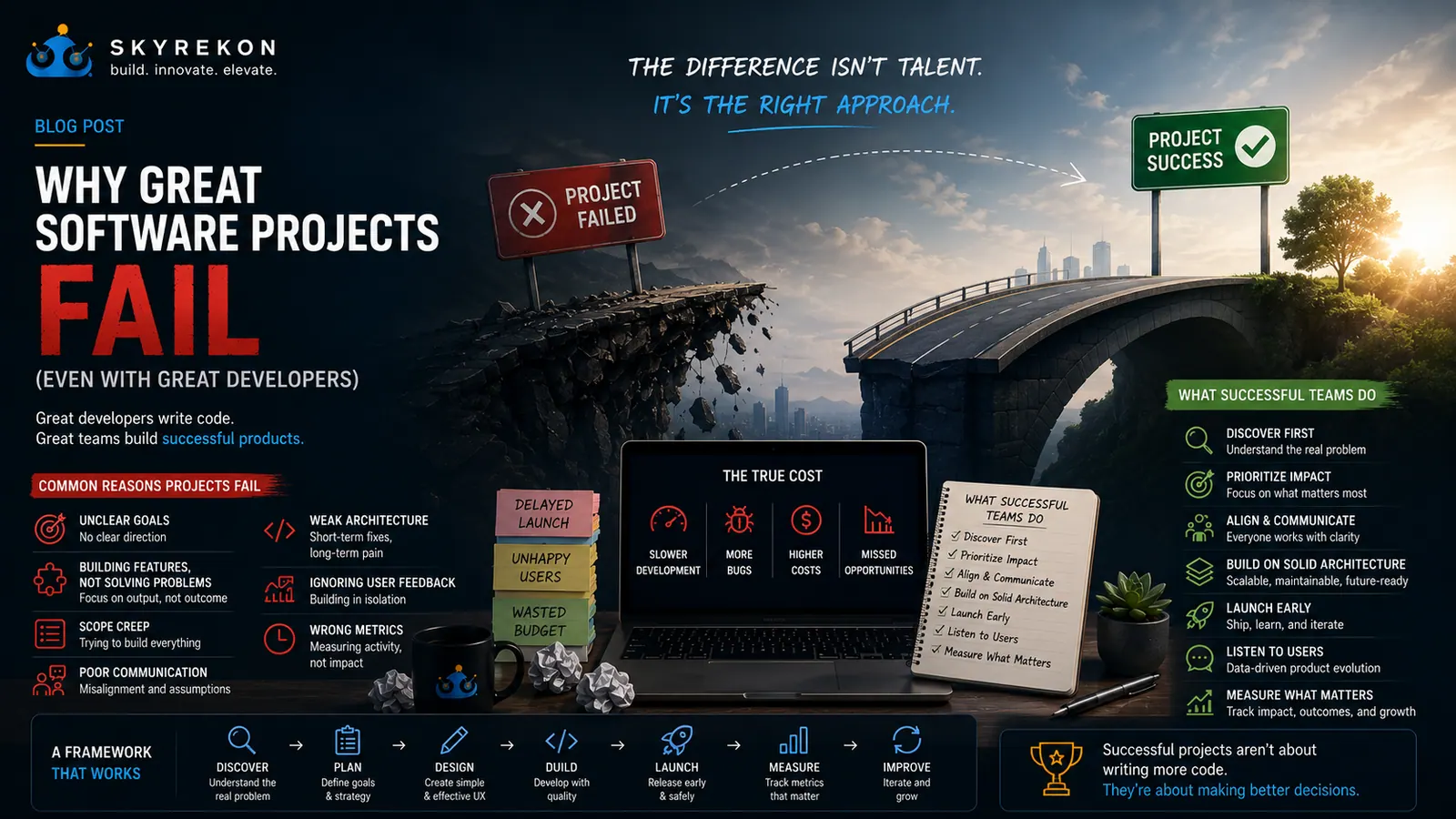
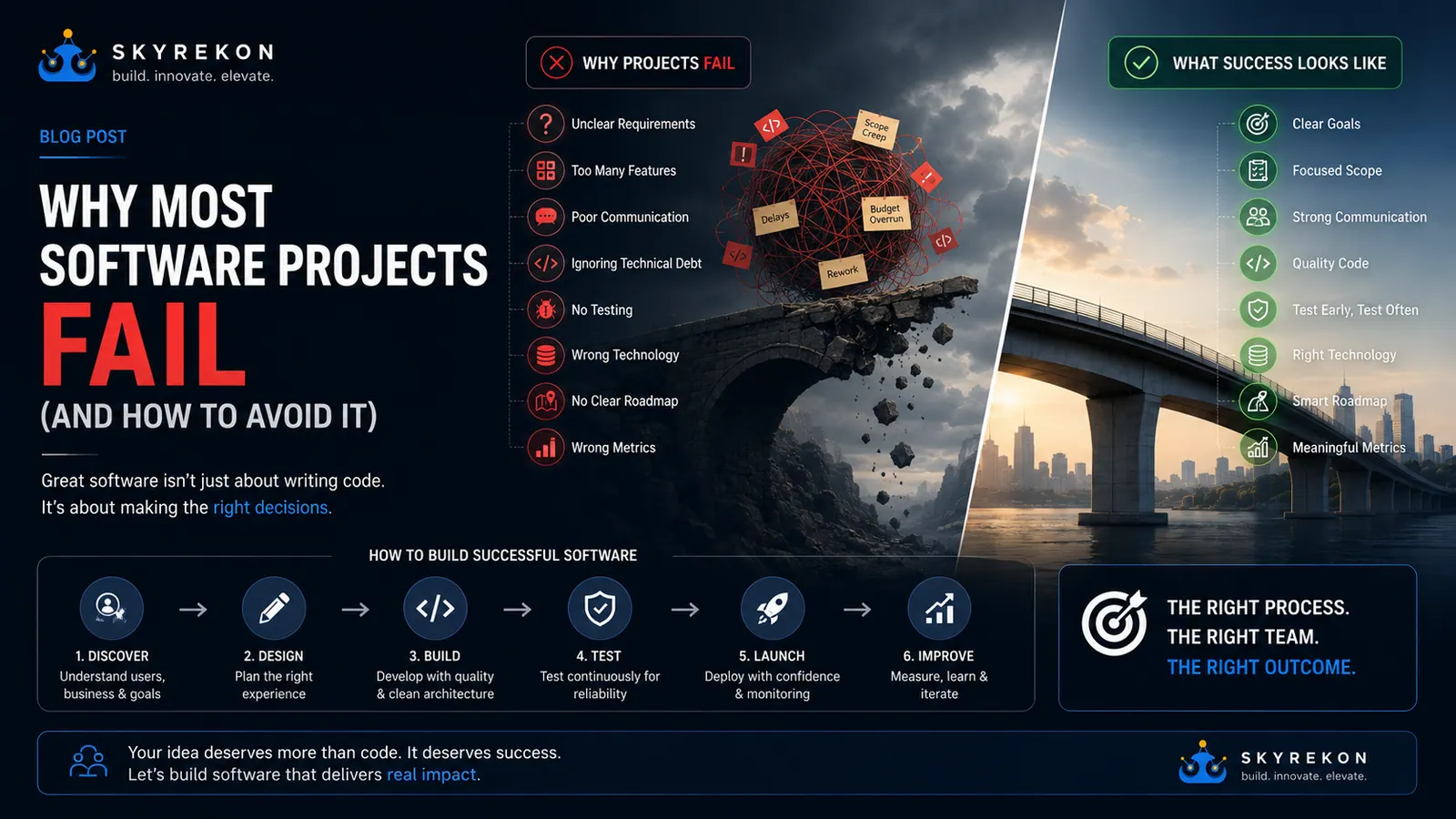
Why Most Software Projects Fail (And How to Avoid It)
Discover why software projects fail and the proven engineering practices that help startups and enterprises deliver successful products on time and within budget.
Building software has never been easier.
Building successful software has never been harder.
Modern frameworks, cloud platforms, AI coding assistants, and low-code tools allow products to be built faster than ever. Yet thousands of software projects still fail every year.
Some never launch.
Some launch and never gain users.
Others become impossible to maintain after just a few months.
The surprising truth is that most failures have very little to do with technology.
They happen because of poor planning, unclear communication, and weak execution.
Let's explore the biggest reasons software projects fail—and how successful teams avoid them.
Failure Starts Before the First Line of Code
Many teams believe software development begins with coding.
It doesn't.
It begins with understanding the problem.
The best engineering teams spend significant time answering questions like:
- Who are we building this for?
- What problem are we solving?
- How will success be measured?
- What should we intentionally avoid building?
Without these answers, development becomes expensive guesswork.
Mistake #1: Building Too Many Features
A common startup mindset is:
"If we launch with more features, customers will love it."
Reality is different.
More features usually mean:
- Longer development time
- Higher costs
- More bugs
- More maintenance
- Slower user onboarding
Successful products focus on solving one problem exceptionally well before expanding.
Remember:
People don't buy features.
They buy outcomes.
Mistake #2: Skipping Product Discovery
Development should never begin with a feature list.
It should begin with understanding users.
Good discovery includes:
- User interviews
- Competitor analysis
- Market validation
- Technical feasibility
- Business goals
A week spent on discovery can save months of unnecessary development.
Mistake #3: Poor Communication
Many projects fail because everyone has different expectations.
Founders expect one thing.
Designers imagine another.
Developers build something else.
Clear communication prevents expensive misunderstandings.
Successful teams document:
- Requirements
- User flows
- Acceptance criteria
- Priorities
- Success metrics
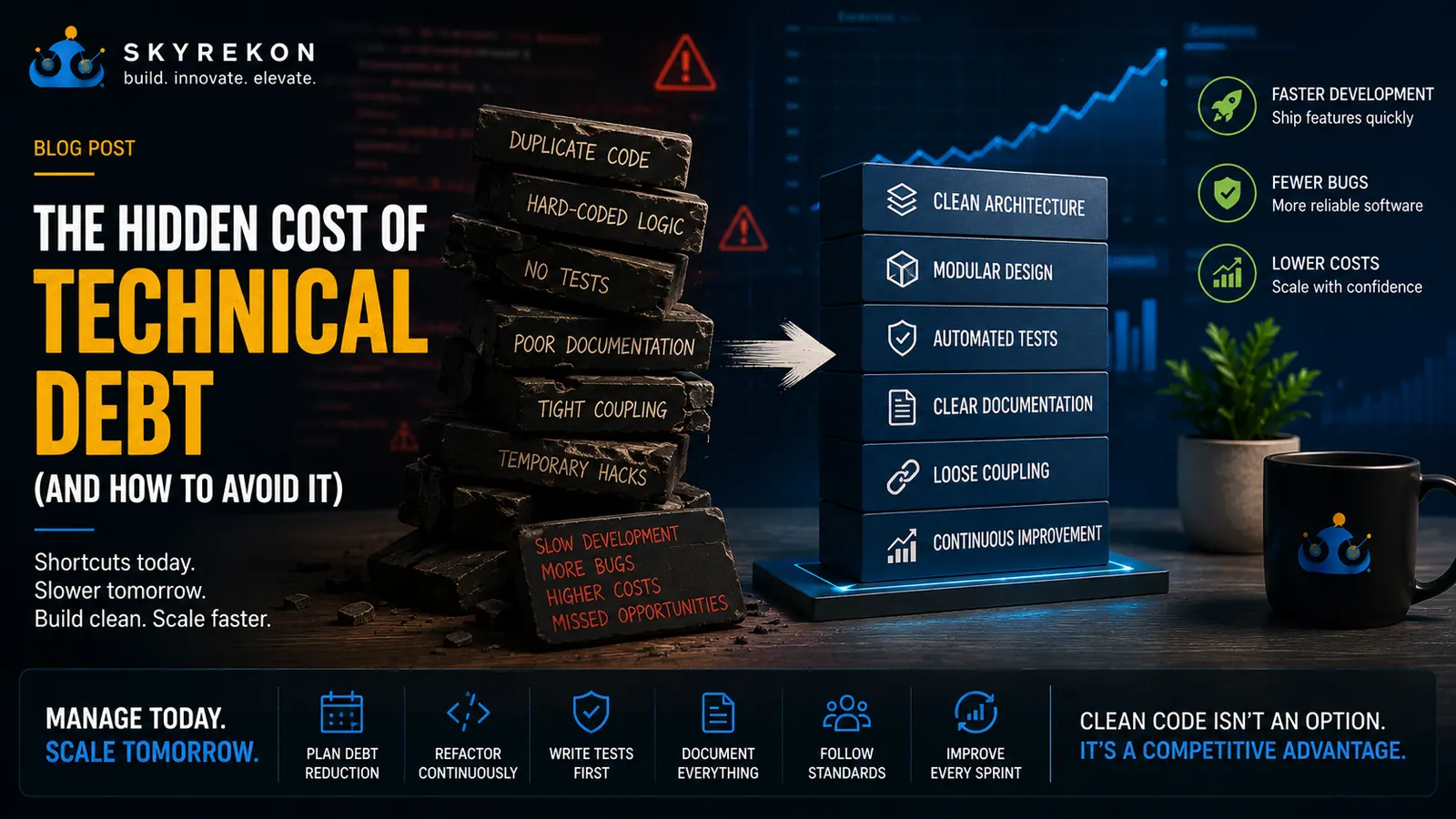
Mistake #4: Ignoring Technical Debt
Moving fast is important.
Ignoring quality isn't.
Technical debt accumulates when shortcuts become permanent.
Eventually, every new feature becomes slower to build.
Small issues grow into major architectural problems.
Engineering quality is an investment—not an expense.
Mistake #5: Choosing the Wrong Technology
Technology decisions should support business goals.
Not trends.
Choosing a framework because it's popular often creates unnecessary complexity.
The best stack is usually:
- Stable
- Well-supported
- Easy to hire for
- Easy to maintain
- Appropriate for the product
Simple often wins.
Mistake #6: No Clear Product Roadmap
Without priorities, everything feels urgent.
Teams jump between ideas.
Deadlines slip.
Focus disappears.
A roadmap creates alignment.
It answers:
- What are we building now?
- What comes next?
- What can wait?
Mistake #7: Not Testing Early
Waiting until launch to test software is expensive.
Testing should happen continuously.
This includes:
- Unit testing
- Integration testing
- Manual QA
- Performance testing
- Security testing
- User acceptance testing
Finding bugs early is dramatically cheaper than fixing them later.
Mistake #8: Ignoring Scalability
Many teams either:
Over-engineer for millions of users...
or
Build something that can't handle a thousand.
Good architecture balances today's needs with tomorrow's growth.
Scalability should be intentional—not accidental.
Mistake #9: Measuring the Wrong Metrics
Shipping software isn't success.
Success comes from measurable outcomes.
Examples include:
- User retention
- Conversion rate
- Customer satisfaction
- Revenue growth
- Reduced operational costs
- Faster workflows
Always measure business impact—not just development progress.
What Successful Teams Do Differently
High-performing engineering teams follow a repeatable process:
Discover
Understand users, goals, and business problems.
Design
Create intuitive user experiences before development.
Build
Develop iteratively with clean, maintainable code.
Test
Validate functionality, performance, and security continuously.
Launch
Deploy confidently with monitoring in place.
Improve
Listen to users.
Measure results.
Iterate constantly.
Software is never truly finished.
How Skyrekon Builds Software
At Skyrekon, we don't simply write code.
We partner with businesses to build products that create measurable value.
Every project follows a structured engineering process focused on:
- Product discovery
- Scalable architecture
- Transparent communication
- Agile development
- Continuous testing
- Secure deployment
- Long-term maintainability
Our goal isn't just to deliver software.
It's to help businesses launch products that grow successfully.
Final Thoughts
Software projects rarely fail because developers can't code.
They fail because teams solve the wrong problems, lose focus, or skip critical planning.
The most successful products aren't built by writing more code.
They're built by making better decisions.
Great software is the result of disciplined engineering, continuous learning, and close collaboration between business and technology.
Planning Your Next Software Project?
Whether you're building an MVP, modernizing an existing platform, or launching a new digital product, Skyrekon helps startups and enterprises transform ideas into scalable software.
Tags
- Software Development
- Product Management
- Startups
- Engineering
- Project Management
Building something similar?
Skyrekon partners with teams on AI-native products, platforms, and engineering systems — from discovery through production.