Product Development
Why Most MVPs Fail (And How to Build One That Doesn't)
Learn why many startups waste months building the wrong MVP and discover a practical engineering-first approach to launching products that customers actually want.
Launching a startup has never been easier.
Launching a successful startup has never been harder.
Thousands of products are released every month, yet most never gain traction. The problem usually isn't poor engineering or lack of effort—it starts much earlier.
Many founders misunderstand what an MVP actually is.
An MVP is not the smallest version of your final product.
It's the smallest product capable of validating a business assumption.
Understanding this difference can save months of development and thousands of dollars.
The Biggest Myth About MVPs
Many teams believe an MVP means:
- Building fewer features
- Shipping quickly
- Designing a basic UI
- Launching as soon as possible
While speed matters, none of these define an MVP.
A successful MVP answers one question:
Will customers actually pay or consistently use this solution?
Everything else is secondary.
Why Most MVPs Fail
1. Building Too Much
Founders often believe they need dozens of features before launching.
The result:
- Months of development
- Growing costs
- Delayed feedback
- No validation
Customers don't care how many features exist.
They care whether one problem is solved exceptionally well.
2. Solving Multiple Problems
A product trying to solve everything usually solves nothing.
Examples:
Instead of building:
- Project Management
- CRM
- HR
- Chat
- Analytics
Start with:
"A faster way for engineering managers to review developer candidates."
Specific wins.
General loses.
3. Skipping Customer Validation
Many teams write code before speaking to users.
Engineering should never replace customer conversations.
Before building:
- Interview potential users
- Understand workflows
- Observe existing pain points
- Identify what people already pay for
Every feature should originate from real customer feedback.
4. Overengineering
Engineers naturally love scalable architecture.
Startups need scalable learning first.
Instead of building:
- Kubernetes
- Microservices
- Event-driven systems
- Distributed architecture
Start with:
- Monolith
- Clean architecture
- Good testing
- Fast deployment
Scale only after customers demand it.
5. Measuring Vanity Metrics
Downloads don't matter.
GitHub stars don't matter.
Website visitors don't matter.
Instead, measure:
- Weekly active users
- Customer retention
- Conversion rate
- Revenue
- Feature adoption
- Customer interviews
Real businesses are built on customer behavior—not page views.
What a Great MVP Looks Like
A great MVP should have:
- One clear problem
- One primary audience
- One measurable outcome
- One success metric
Everything else can wait.
Start With the Problem, Not the Technology
Bad process:
"We should build an AI platform."
Better process:
"Recruiters spend six hours reviewing resumes."
Technology is simply the tool.
The problem creates the product.
Focus on Core User Flow
Ask yourself:
If a user only performs one action, what should it be?
Examples:
Netflix:
Watch a movie.
Uber:
Book a ride.
Dropbox:
Store a file.
Skillron:
Complete a real-world engineering challenge.
Everything else supports that experience.
Ship Earlier Than You're Comfortable With
One common mistake is waiting until everything feels perfect.
Reality:
Customers rarely care about perfection.
They care about usefulness.
Launch.
Collect feedback.
Improve continuously.
Great products evolve with users—not before them.
Build for Learning
Every sprint should answer a question.
Examples:
- Do users complete onboarding?
- Which feature is used first?
- Why do users abandon checkout?
- Are customers willing to pay?
If your product isn't teaching you something every week, you're building blindly.
Common MVP Mistakes
Avoid these:
- Building admin panels first
- Spending months polishing UI
- Adding authentication for every feature
- Building dashboards before collecting data
- Creating advanced settings no one requested
- Optimizing performance before acquiring users
Every unnecessary feature delays learning.
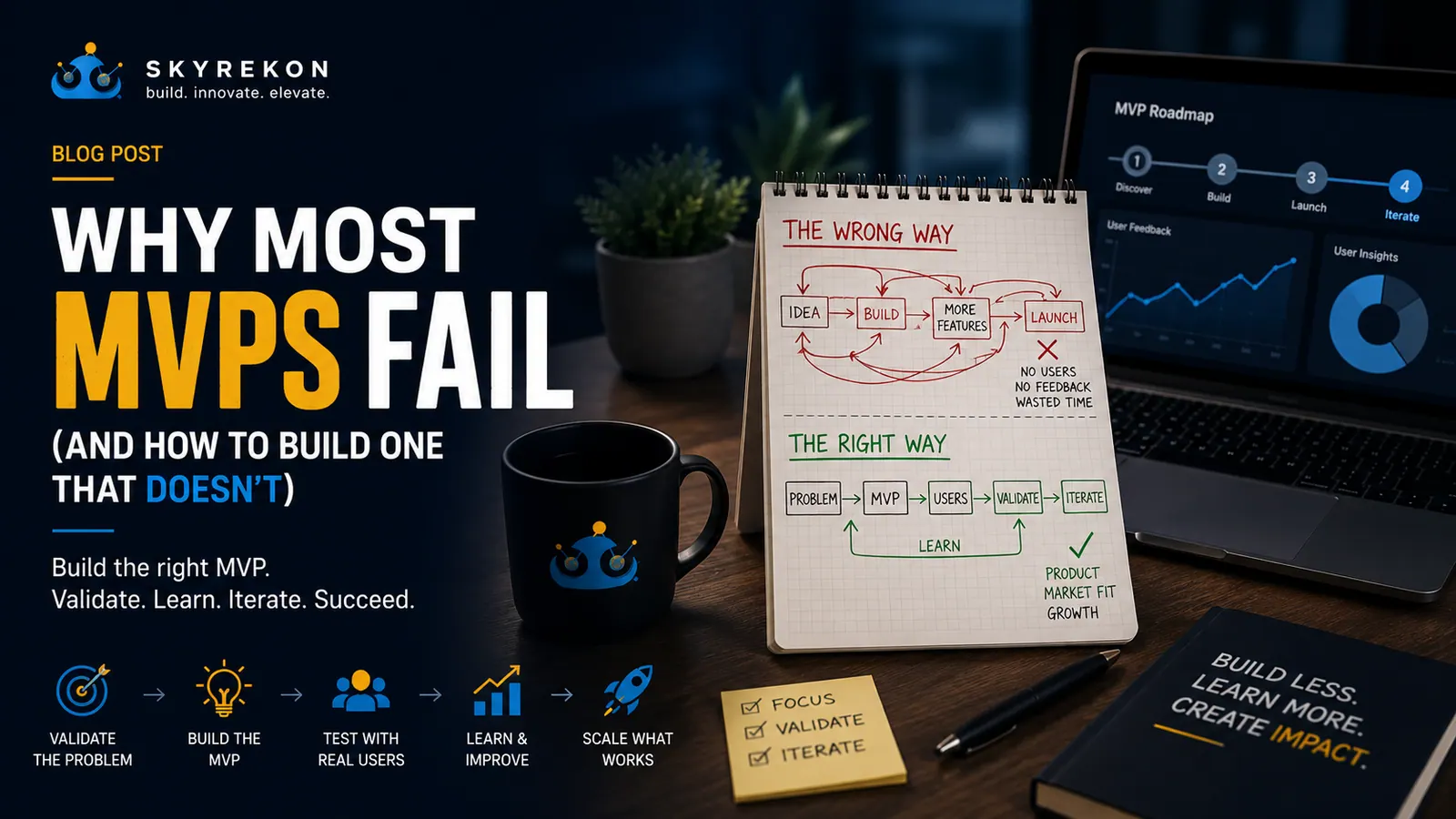
A Better MVP Framework
At Skyrekon, we recommend this sequence:
Step 1 — Discovery
Understand:
- Customer pain
- Existing workflow
- Competitors
- Market opportunity
Step 2 — Validation
Validate through:
- Interviews
- Landing pages
- Waitlists
- Prototypes
- User testing
Step 3 — MVP Development
Build only:
- Core functionality
- Authentication
- Essential analytics
- Error handling
Nothing more.
Step 4 — Launch
Release quickly.
Gather real usage data.
Observe user behavior.
Talk to customers.
Step 5 — Iterate
Every release should improve based on evidence—not assumptions.
Technology Should Support the Business
The best architecture is the one that helps you learn faster.
Choosing technologies because they're popular rarely creates successful companies.
Choose tools that help your team ship reliably.
Real Success Comes From Iteration
Products like:
- Airbnb
- Dropbox
- Slack
- Notion
Did not launch with hundreds of features.
They launched with one compelling experience.
Then improved relentlessly.
Final Thoughts
An MVP isn't about building less.
It's about learning more.
The companies that win aren't necessarily the ones with the largest engineering teams.
They're the ones that understand customers faster than everyone else.
Build with purpose.
Launch early.
Measure everything.
Improve continuously.
That's how successful products are created.
How Skyrekon Helps
At Skyrekon, we help startups transform ideas into production-ready products without wasting months building unnecessary features.
Our engineering team focuses on:
- Product discovery
- MVP architecture
- Web & mobile development
- AI-powered applications
- Cloud infrastructure
- Long-term product scaling
Whether you're validating your first idea or preparing to scale, we help you build products that are engineered for growth—not just launch.
Tags
- MVP
- Startup
- Product Development
- Software Engineering
- SaaS
Building something similar?
Skyrekon partners with teams on AI-native products, platforms, and engineering systems — from discovery through production.