Product Development
Why Every Startup Should Build an MVP Before a Full Product
Building a full product before validating the idea is one of the biggest startup mistakes. Learn why successful startups begin with an MVP and how to build one correctly.
One of the most expensive mistakes founders make isn't writing bad code.
It's building features nobody actually needs.
Every year, thousands of startups spend months—or even years—building products they believe customers will love. Then launch day arrives.
No users.
No traction.
No revenue.
The problem usually isn't poor engineering.
It's a lack of validation.
That's why successful startups don't start with a complete product.
They start with an MVP.
What Is an MVP?
MVP stands for Minimum Viable Product.
It is the smallest version of your product that delivers a single core value to real users.
The goal isn't perfection.
The goal is learning.
A good MVP answers one critical question:
Will people actually use this?
MVP Doesn't Mean Low Quality
Many founders misunderstand MVP.
They think it means:
- ugly UI
- broken experience
- missing security
- unfinished product
That's not an MVP.
That's simply bad software.
A real MVP should be:
- reliable
- usable
- fast
- focused
It solves one problem extremely well instead of solving ten problems poorly.
Build One Feature Exceptionally Well
Imagine you're building a project management platform.
Instead of launching with:
- projects
- tasks
- chat
- calendar
- AI assistant
- reporting
- invoicing
- automation
- analytics
- mobile apps
Ask yourself:
What is the single reason users would sign up today?
Maybe it's simply:
AI-powered task generation.
Build that first.
Launch.
Learn.
Expand later.
Why Startups Fail Without an MVP
A common timeline looks like this:
Month 1
Planning
Month 2
Design
Month 3
Development
Month 4
Authentication
Month 5
Payments
Month 6
Notifications
Month 7
Analytics
Month 8
Admin Panel
Month 9
Marketing Website
Month 10
Launch
Only then do founders discover:
Customers don't actually need it.
Ten months wasted.
What an MVP Should Validate
Your MVP should answer questions like:
- Is the problem real?
- Will users sign up?
- Will they return?
- Will they pay?
- Which features matter most?
- Which features nobody uses?
These answers are impossible to get from brainstorming sessions.
Only real users can provide them.
The Cost of Building Too Much
Every unnecessary feature costs:
- engineering time
- testing
- maintenance
- documentation
- customer support
- infrastructure
More features also make products harder to understand.
Simple products often win because they're easier to adopt.
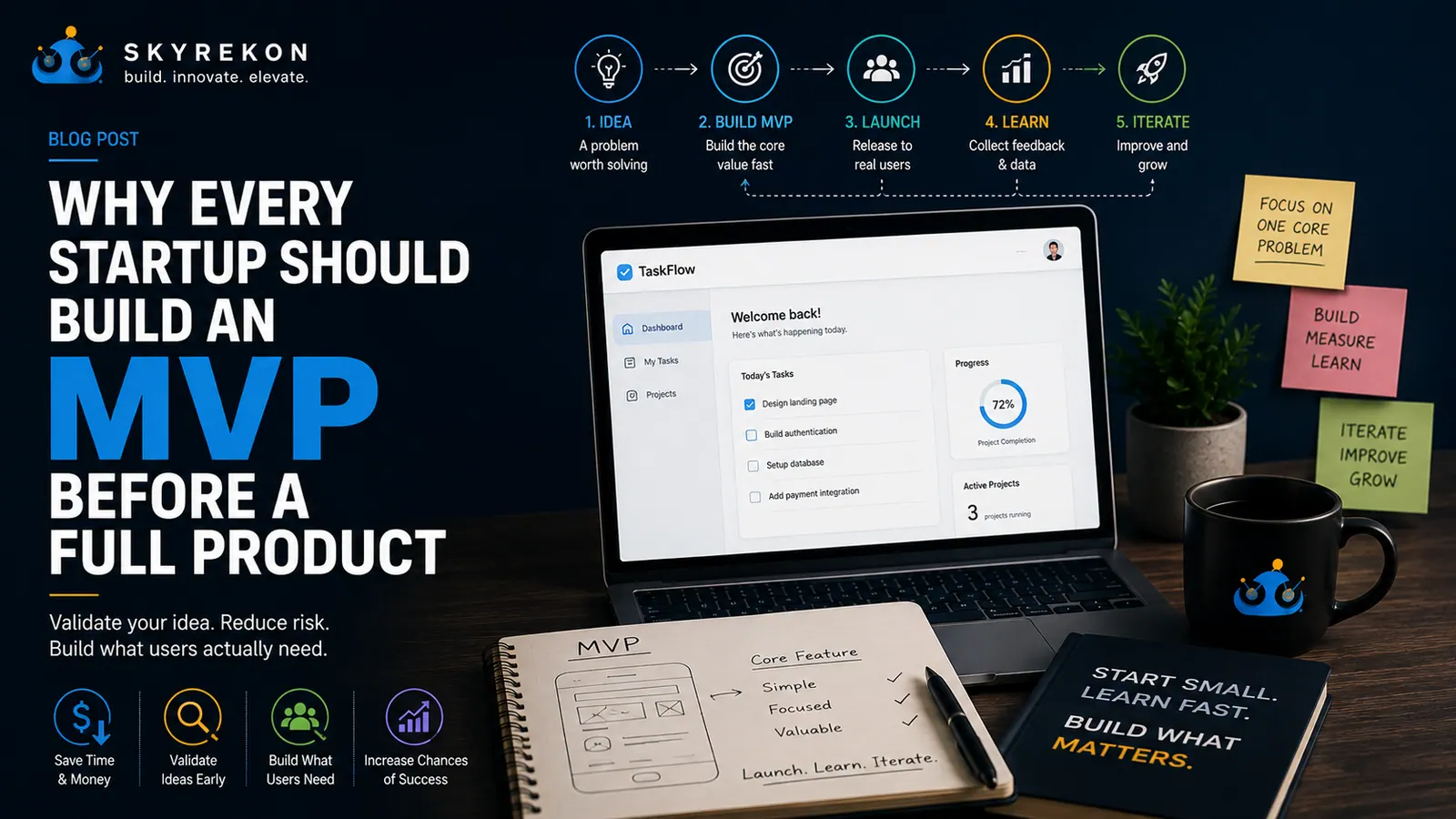
Build → Measure → Learn
The best startup teams follow a continuous cycle.
Idea
↓
Build
↓
Launch
↓
Collect Feedback
↓
Improve
↓
Repeat
Every release teaches something.
Every iteration reduces risk.
Common MVP Mistakes
Building for Everyone
Trying to satisfy every possible customer usually satisfies none.
Start with one audience.
Waiting for Perfection
Perfection delays learning.
Launch when the core experience is solid.
Improve continuously afterward.
Adding Features Instead of Solving Problems
Features don't create value.
Solutions do.
Every new feature should solve a real customer pain point.
Ignoring User Feedback
Your roadmap shouldn't come from assumptions.
It should come from customers.
Listen carefully.
Prioritize ruthlessly.
How We Build MVPs at Skyrekon
Our process is intentionally simple.
Discovery
Understand the business problem.
Prioritization
Identify the single most valuable feature.
Design
Create clean, intuitive user flows.
Development
Build only what's necessary for launch.
Deployment
Release quickly with reliable infrastructure.
Feedback
Collect real-world usage data.
Iterate
Improve based on evidence—not opinions.
MVP Doesn't Mean Temporary
Some MVPs evolve into products serving millions of users.
Companies like Airbnb, Dropbox, and Facebook all started with surprisingly small versions of the products we know today.
Their advantage wasn't building everything.
It was learning faster than everyone else.
Signs Your MVP Is Ready
You don't need every feature.
You need enough value that users are willing to:
- sign up
- use it
- recommend it
- return
- pay
If those things happen consistently, you've validated your direction.
Now you can invest confidently.
Final Thoughts
Great products aren't built all at once.
They're discovered through continuous learning.
Every feature should earn its place.
Every release should answer a question.
Every customer conversation should shape the roadmap.
An MVP isn't about shipping less.
It's about learning more.
The faster you learn, the faster you build something people genuinely want.
Build Your MVP With Confidence
Whether you're validating a new SaaS idea or launching your first startup, Skyrekon helps founders move from concept to production-ready MVP without unnecessary complexity.
Let's build the right product before building a bigger product.
Tags
- MVP
- Startup
- Product Development
- SaaS
- Product Strategy
Building something similar?
Skyrekon partners with teams on AI-native products, platforms, and engineering systems — from discovery through production.