DevOps
Docker vs Kubernetes: What Growing Startups Actually Need
Confused between Docker and Kubernetes? Learn when startups should use Docker, when Kubernetes becomes necessary, and how to avoid overengineering your infrastructure.
One of the most common mistakes early-stage startups make is adopting infrastructure that's far more complex than they actually need.
A team of three engineers deploys Kubernetes because "that's what big companies use."
Six months later they're spending more time maintaining infrastructure than building features.
Here's the truth:
Docker and Kubernetes solve different problems.
Understanding that difference can save months of engineering time and thousands of dollars.
Docker Isn't Kubernetes
People often compare Docker and Kubernetes as if they're competing technologies.
They're not.
Think of it like this:
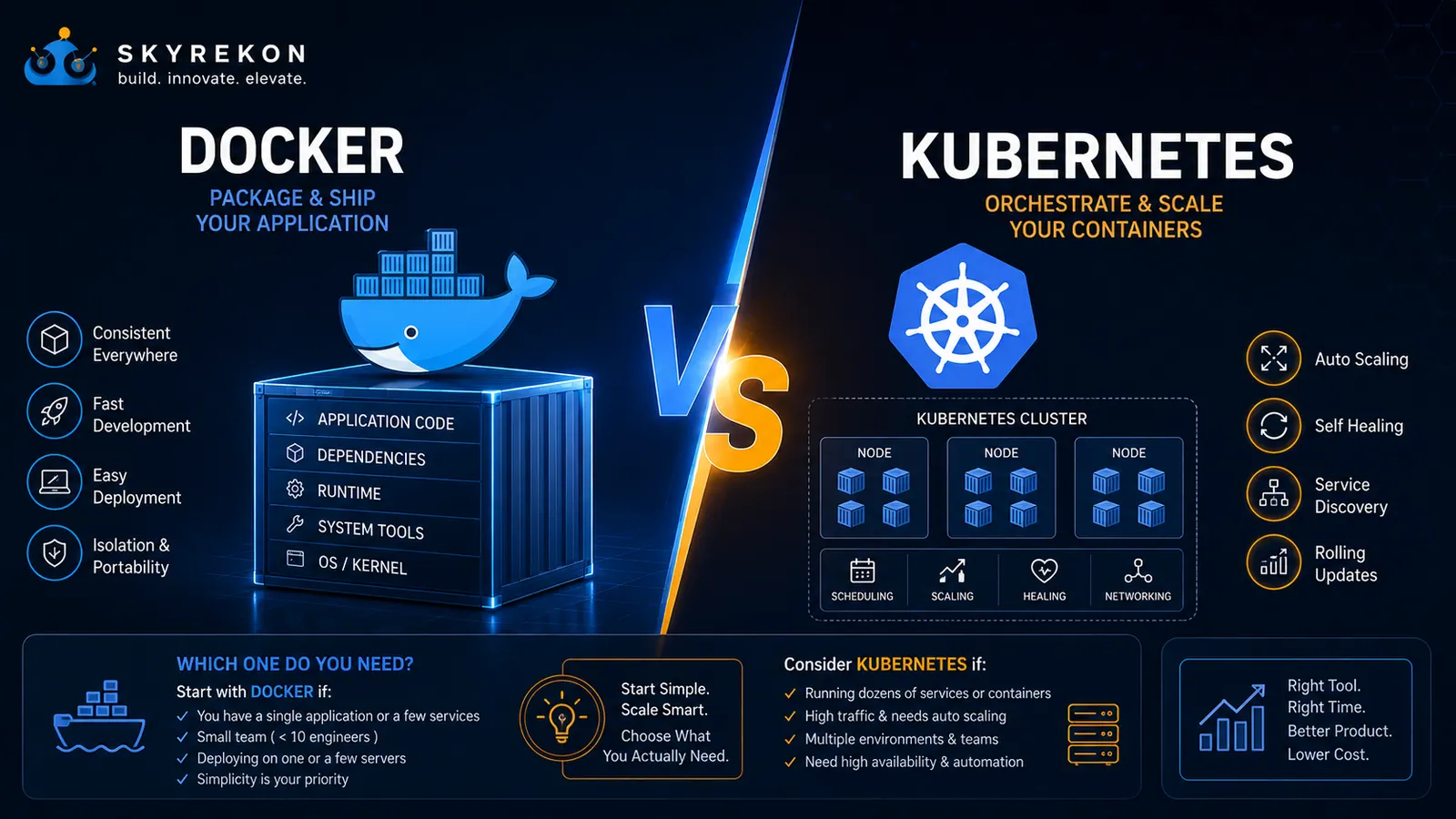
- Docker is a shipping container.
- Kubernetes is the global shipping port that manages thousands of containers.
Docker packages applications.
Kubernetes manages large numbers of Docker containers.
You usually use Kubernetes because you're already using containers.
What Docker Solves
Docker makes applications portable.
Instead of saying:
"It works on my machine."
You package:
- application
- dependencies
- runtime
- configuration
into one container.
That container behaves almost identically everywhere.
Whether you're running:
- your laptop
- staging
- production
- cloud server
the application remains consistent.
What Kubernetes Solves
Running one container is easy.
Running hundreds is not.
Questions quickly appear:
- Which server should run this container?
- What happens if one crashes?
- How do we scale during traffic spikes?
- How do we update without downtime?
- How do we distribute traffic?
That's Kubernetes.
It automates:
- scheduling
- scaling
- failover
- networking
- rolling deployments
- service discovery
When Docker Alone Is Enough
For most startups, Docker is enough.
Typical setup:
- Next.js frontend
- NestJS backend
- PostgreSQL
- Redis
- Nginx
Everything runs through Docker Compose.
Deployment becomes:
git pull
docker compose up -d
Done.
No cluster.
No control plane.
No YAML nightmare.
When Kubernetes Makes Sense
Kubernetes becomes valuable when you're operating at scale.
Examples:
- dozens of microservices
- multiple production regions
- hundreds of deployments
- many engineers deploying daily
- automatic scaling requirements
- strict availability targets
At that point, manual container management stops being practical.
Warning Signs You're Adopting Kubernetes Too Early
If these sound familiar, wait.
- Team has fewer than 10 engineers
- One production server
- One application
- Low traffic
- No dedicated DevOps engineer
- Deployments happen once or twice per week
Adding Kubernetes here usually increases complexity without delivering meaningful benefits.
The Hidden Cost of Kubernetes
People often look only at infrastructure costs.
The real cost is engineering time.
Kubernetes introduces concepts like:
- Pods
- Nodes
- Deployments
- ReplicaSets
- Services
- Ingress
- ConfigMaps
- Secrets
- StatefulSets
- Persistent Volumes
Each requires learning.
Each can fail.
Each requires debugging.
Infrastructure complexity compounds quickly.
A Practical Startup Infrastructure
Here's what we recommend for most SaaS startups.
Cloud VM
│
├── Docker
├── Docker Compose
├── Reverse Proxy
├── PostgreSQL
├── Redis
├── Application
├── Monitoring
└── Automatic Backups
Simple.
Reliable.
Easy to understand.
Easy to hire for.
Scaling Without Kubernetes
Many teams assume Kubernetes is required for scaling.
It isn't.
You can scale surprisingly far using:
- larger servers
- multiple Docker containers
- load balancers
- managed databases
- CDN
- caching
- queue workers
Many successful SaaS companies reached millions in revenue before adopting Kubernetes.
When You Should Consider Kubernetes
Ask yourself these questions.
Are deployments becoming painful?
Do services frequently compete for resources?
Are you managing dozens of containers?
Do you need automatic recovery?
Are multiple engineering teams deploying independently?
If the answer is consistently yes, Kubernetes may be the next logical step.
Common Startup Journey
Stage 1
Single server
↓
Docker
↓
Docker Compose
↓
Growing traffic
↓
Load balancer
↓
Multiple application servers
↓
Container orchestration
↓
Kubernetes
Notice Kubernetes appears much later.
Not first.
Our Recommendation
For most startups:
- Use Docker immediately.
- Use Docker Compose for deployment.
- Automate backups.
- Add monitoring.
- Keep infrastructure understandable.
Only adopt Kubernetes once operational complexity—not hype—demands it.
Great infrastructure isn't the one with the most buzzwords.
It's the one your team can confidently operate every day.
Final Thoughts
Infrastructure should accelerate product development—not become the product itself.
Docker gives startups consistency, portability, and reliable deployments with minimal operational overhead.
Kubernetes is an exceptional platform when your scale genuinely requires orchestration.
Choose the simplest solution that solves today's problem.
Your future team will thank you.
Need Help Designing Scalable Infrastructure?
Whether you're deploying your first SaaS application or planning infrastructure for rapid growth, Skyrekon helps startups build secure, scalable platforms without unnecessary complexity.
Let's build infrastructure that grows with your business—not ahead of it.
Tags
- Docker
- Kubernetes
- DevOps
- Infrastructure
- Startups
Building something similar?
Skyrekon partners with teams on AI-native products, platforms, and engineering systems — from discovery through production.